




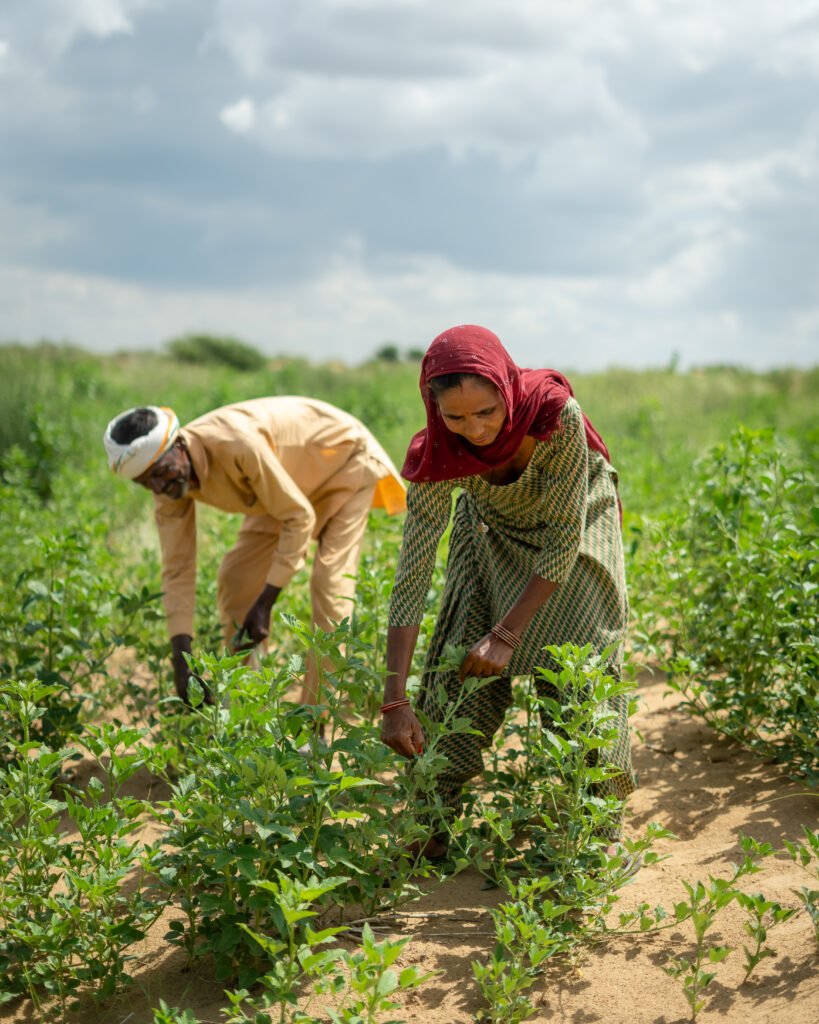
The state of Rajasthan is renowned for many things—its desert expanses, its vibrant culture, and its thriving brick industry. It is also one of India’s largest producers of mustard seeds, with an estimated annual production of 27 lakh tonnes, accounting for nearly 45 percent of the nation’s output.
Mohini, a 51-year-old bonded labour survivor from the Bawri community (classified under the Scheduled Caste/Scheduled Tribe category), lives in Rawla Mandi, a village near the edge of Rajasthan’s Thar Desert. On a hot monsoon afternoon, we set out to meet this emerging survivor leader in her hometown.
When we asked where we could meet, she suggested a house in this village. We arrived to find a brick-walled compound with a small metal door that opened into a spacious front yard, shaded by a large tree. At its far end stood a two-room thatched-roof house.
Mohini greeted us with her warm smile, standing with her husband, Mohan, and a few relatives under the tree’s shade. This spacious house wasn’t Mohini’s; it belonged to her brother-in-law. In fact, she has never owned a home. She and her family have spent their entire lives on kilns, moving from one site to another.
‘My biggest dream,’ she tells us, ‘is to have a home of my own—where I can one day welcome you all in, at least for a cup of tea.’
A Life Built Around by Bricks
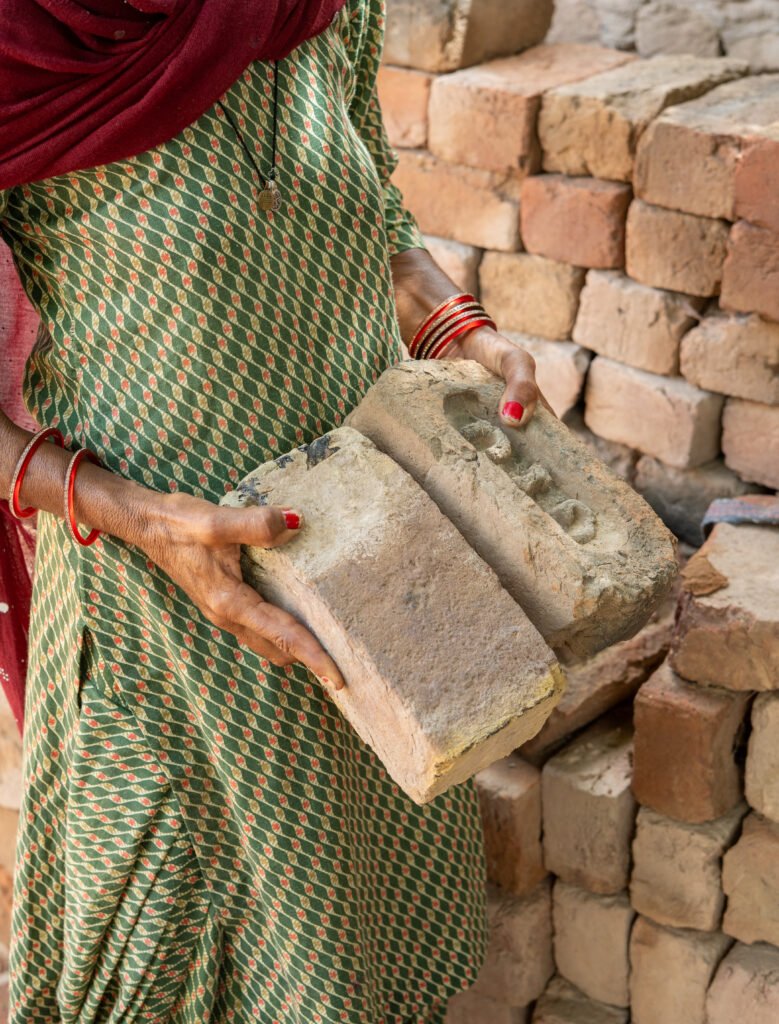
Throughout her life, Mohini has been around brick kilns. Her family has worked in the brick industry for generations. This background meant she never had the chance to attend school, as she needed to support her family and eventually became skilled in brick making. In fact, it has been the only skill she has learnt in her life.
At a young age, she married Mohan Lal from Hanumangarh, whose family had spent their lives residing and working in kilns. Since their wedding, Mohini has worked alongside her husband. For many years, they moved from one kiln to another, mostly at the owners’ insistence.
Over time, the couple had five children—two sons and three daughters. Two daughters, Geeta and Sunita, are married and live at other kilns, while their other children, Sunil and his wife, Krishan, and Kiran, continue to stay with them.
Due to the family’s financial situation and other illnesses, her children have not studied beyond class 7.
Bricks to Bondage
In 2021, their lives took a turn for the worse. They moved to KVR Bricks in Sangaria, Rajasthan, after taking an advance of ₹30,000. As before, they were paid per brick made, but over time, the payments became irregular and eventually stopped altogether.
‘We made 3000 bricks a day and were paid ₹2,000 for the work once every 20 days,’ Mohini recalls. ‘Then, the payment gaps grew longer, until there was no payment at all. Even our rations were cut.’
What seemed like ordinary work soon became a form of captivity. Their movement was restricted, and the owner monitored them closely through surveillance cameras. The fear of being caught on camera stopped them from trying to escape.
They lived in makeshift jhuggis—mud-and-metal shelters with tattered roofs that flooded when it rained and had no electricity. But the unsafe homes were the least of their worries. The owners and supervisors routinely abused the workers, beating them whenever they asked for any money, even their wages.
‘Once, my sister-in-law’s sons fought over a family matter. The next morning, when the owner came to his office, the supervisor complained about their fight. The owner then called the boy to his office, beat him badly, and broke his arm. When my son questioned them, they threatened and abused him, too,’ she says.
Among the four families at the kiln, Mohini’s was the only one from Rajasthan’s Bawri caste; the others were migrants from Uttar Pradesh (UP). Mohini recounts how a 13-year-old girl from one of the families narrowly escaped a sexual assault by a supervisor who entered her jhuggi.
‘She ran out screaming for help,’ Mohini recalls. ‘Her parents were at work, so she came to me. I tried to comfort her.’ When the girl’s parents confronted the supervisor, they were beaten. The owner dismissed the incident, claiming ‘no camera had recorded it.’
According to Mohini, such assaults were frequent. In fact, it was a recurring pattern where both the owner and the supervisor would often enter these homes when no one else was present to sexually abuse young girls and women. When challenged, they would protect each other, accuse the victims of lying, and escalate to violence.
The final blow came when Mohini’s mother fell ill. ‘I begged for money to visit her but they refused, not even ₹50 as money to travel there,’ she says.
By the time her daughter Geeta sent money, her mother had passed away. Mohini was allowed to attend the funeral alone, leaving her husband and children behind.
When she returned, the payments had stopped entirely; they had even stopped getting ration from the shop. Fear and despair grew with every passing day. Finally, after enduring over six to seven months of abuse and confinement, Mohini and her family decided they’d had enough.
Finding Freedom
In April 2022, Mohini, Mohan and a fellow labourer from UP, Bhura Ram, managed to contact a social worker from the non-governmental organisation (NGO) Jai Bhim Vikas Shikshan Sansthan (JBVSS) using a phone they had kept hidden. One day, Mohan, Bhura Ram, along with another man from UP, hid among the mustard plants surrounding the kiln and slipped out from the back. They braved themselves and managed to go out, despite the chances of being caught by the supervisor. They then met the JBVSS representative, and shared everything they had endured.
JBVSS then prepared a report with the basic case details and filed a complaint online. The very next evening, the Sangaria Police, along with officials from the district legal services authority, the district magistrate (DM), the sub-district magistrate, the tehsildar and JBVSS, arrived at the kiln to help the labourers.
The police recorded the families’ statements and provided the labourers with food and tea. Since it was late, the officials stayed overnight and assisted the workers in returning to their hometowns the next morning. While the other families returned to Uttar Pradesh, Mohini and her family went back to Shri Ganganagar.
‘Even as we left the kiln, the owner hurled abuses, threatening to shoot us if we ever set foot in Sangaria again. To this day, I am terrified to go back there,’ Mohini says.
The case was settled within the kiln premises,and no formal charges were pressed against the perpetrators. The victims received their pending wages—₹2,02,100 in total—which was distributed among the four families. However, the district administration did not officially recognise them as bonded labourers, which meant no bonded labour-specific charges or FIR was filed, and no Release Certificates were issued. This also meant that they were not able to access the ‘Central Sector Scheme for Rehabilitation of Bonded Labourer – 2021’. They later received their identity cards including PAN, Aadhaar and non-cash benefits like ration cards, as well as bank accounts.
Despite the lack of proper procedure, which could have established that they were rescued victims of bonded labour, Mohini’s perception of law enforcement has changed. ‘Earlier, I was intimidated by the thought of the police; I don’t even remember why. But now, after our rescue, I know they are here to protect us.’
Back at a Kiln, at Her Own Terms
Today, Mohini works at a brick kiln, but no longer as a bonded labourer. She earns ₹5,000 for every 20,000 bricks, once in 20 days, supplemented by agricultural work at ₹400 a day. While this is still low, for the first time in her life, she feels a sense of freedom.
The government is supporting Mohini and her family rebuild their lives, offering guidance and counselling that helped them regain confidence and independence. Both Mohini and her son, Krishan, have shown remarkable progress, showcasing their potential as upcoming survivor leaders within their community.
Mohini has also approached government officials about the benefits she was entitled to. She recalls, ‘I told the DM that since my marriage, I had never lived in a house of my own and that whenever someone visits us, it’s always at a kiln. I told her about all the challenges I faced, especially raising a family in a kiln’s environment. With the help of the NGO URMUL, I then submitted applications for the Pradhan Mantri Awas Yojana and a Mahatma Gandhi National Rural Employment Guarantee Act (MGNREGA) card.’
This determination paid off when she finally received her MGNREGA card—a small but meaningful victory. However, her most significant goal remains securing a home. Even four years after her rescue, the process continues to encounter obstacles. Mohini’s resolve extends to her children as well. She is determined that they will never return to bondage. Her younger son, Krishan, gives her the most hope; although he dropped out of school early, he is now pursuing vocational training.
In the long run, Mohini hopes to guide others out of bondage. ‘If we ever get the chance to help someone, we will show them the way to the police and ensure they find freedom,’ she says.
Once she secures a house, she plans to open a small provision and bangle shop to give her family stability.
‘If this dream comes true, I will never go back to the kiln. I want to make sure that everyone in my community who needs help will get it, and that I’ll be there for them whenever they need me,’ she says, her voice steady with hope.