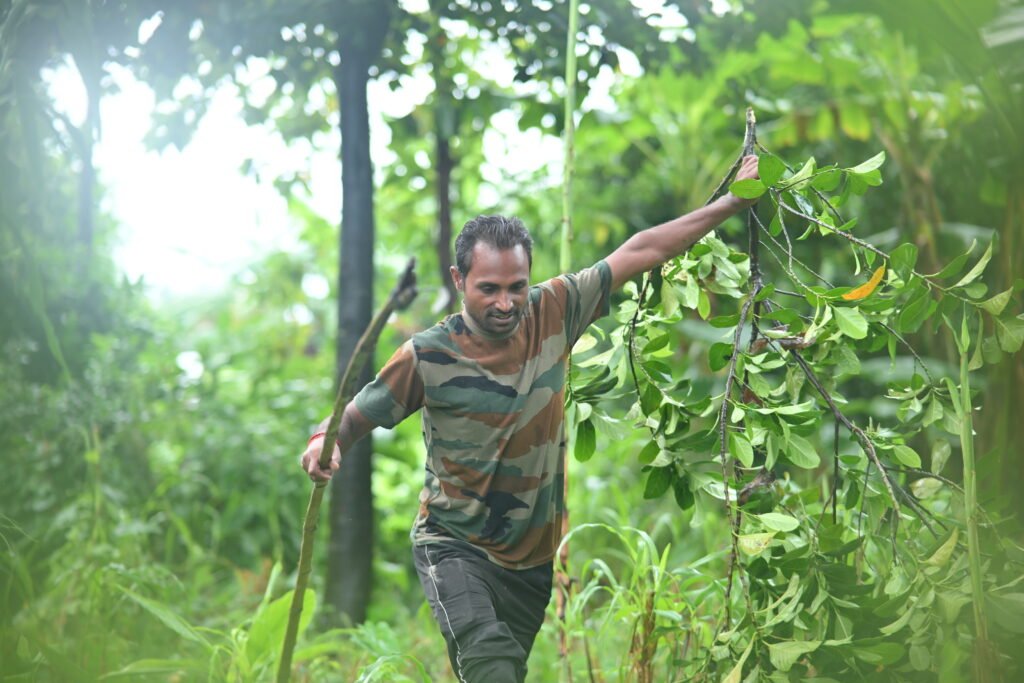

In early 2025, the Government of India announced that 100 survivors of bonded labour would be felicitated at the 79th Independence Day celebrations held in Delhi—a non-explicit but unprecedented acknowledgement of the issue at the highest echelons of the government. Among them were two survivors representing Bihar, Pitambar and his brother Parmeshwar Sah.
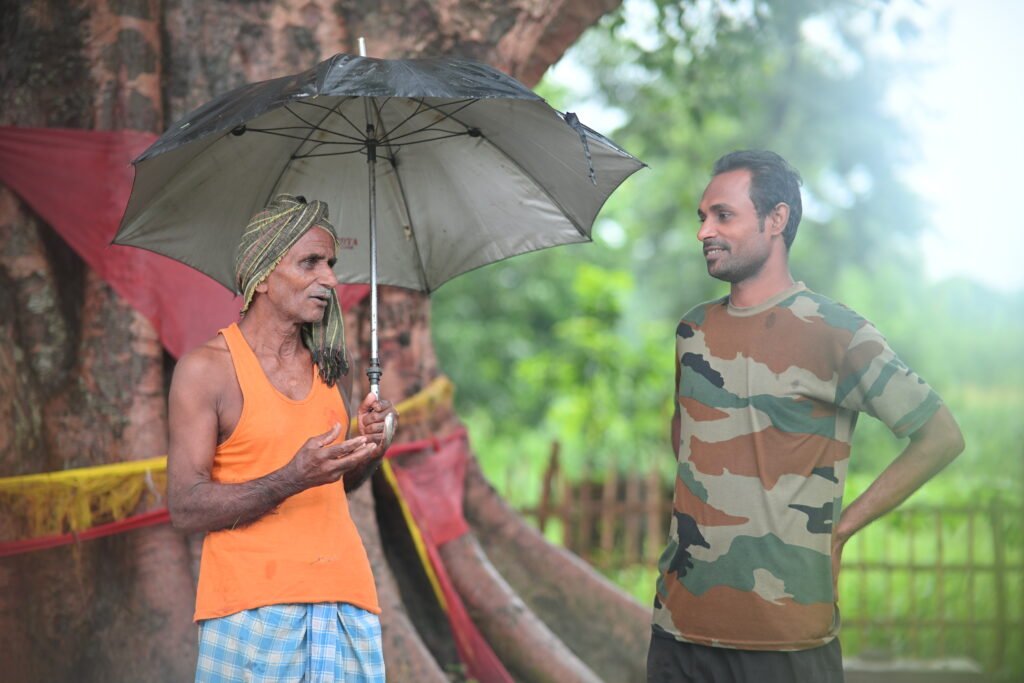
We travelled to West Champaran, a district in northern Bihar, to meet Pitambar and his family—to hear their story and learn about their experiences at the Independence Day celebrations in Delhi.
A month before the event, the two brothers were called by the district administration to sign some papers and present their identification documents.
‘A few days later, we received a call from what we thought was the income tax department; we were terrified. I panicked and lied that I was away before disconnecting,’ Pitambar says light-heartedly.
It is ironic that despite living in such poverty that a social event or an unexpected expense can derail their lives, Pitambar and his family still fear a call from the tax department.
The day we met Pitambar, it was raining. The area around his house was waterlogged, so he, his wife and two daughters (aged four and one) had temporarily moved to his parents’ larger house nearby. Before taking us to his house, Pitambar advised us to take our shoes off and handed us four pairs of slippers—all belonging to him. We waded through flooded fields to reach his small mud house, which has a small yard with four cylindrical mud-and-cow-dung structures to store grains.
The Promise That Turned into Exploitation
Pitambar grew up in extreme poverty with his five brothers and one sister. Their father, a cycle-rickshaw puller, was the family’s sole breadwinner, so all the boys started working at a young age. After finishing class 8, Pitambar began working as a manual labourer, loading and unloading cargo trucks in various cities. In 2023, when Pitambar was 34 years old, his family needed money for his younger brother Parmeshwar’s wedding. They came into contact with a construction contractor through an acquaintance from their village. The contractor offered them a job at his construction site in Solapur, Maharashtra. He also promised that they would have the opportunity to earn extra money by working consecutive shifts every day. Hoping to earn enough money for the wedding, Pitambar went to work at the construction site with Parmeshwar and two older brothers.
At the construction site, the four brothers worked double shifts for weeks without pay. Every time they asked the contractor for money, he deferred the payment to a later date. After about two months, the two older brothers, burdened by family responsibilities, ran away from the site leaving Pitambar and Parmeshwar responsible for collecting their wages from the contractor. Pitambar stopped working overtime; however, the contractor had warned him that stopping work completely would result in forfeiture of the entire wage amount owed to him. He continued to work in the hope of getting paid. He used to receive food supplies once a week from a nearby shop. There was an iron container at the site in which all the workers used to sleep at night.
‘During the day, the container used to become as hot as a furnace. On days when there was less work, we had to take shelter under the shade of a tree nearby,’ Pitambar recollects.
After about six months, the shopkeeper stopped providing food supplies to the workers due to the nonpayment of his dues. Pitambar and other workers grew increasingly agitated, stopped working completely and started pressing the contractor to pay their wages. He hadn’t eaten for a few days and had no money to return home even if he wanted to leave everything and go. One day, in the odd early morning hours, one of the workers noticed that the contractor’s room had been emptied. He had run away with all his belongings. Pitambar and others searched the whole facility.
They even went to the railway station to look for him, but he was nowhere to be found. Worn out and dejected, Pitambar returned to the facility only to be accosted by the shopkeeper who locked him and others up in the container and demanded that they pay the dues owed to him.
After an entire day of arguments, the shopkeeper finally surrendered to the pleadings of the workers and agreed to take them to the office of the construction company. At the office, the manager abused and threatened the workers and blamed them for the loss to the company. He claimed that the company had paid the contractor in full, including the workers’ compensation, and that it was their responsibility now to complete the construction work.
A Call for Help: Rescue and Relief
When all hope was lost, Pitambar mustered up the courage to call the local police and ask for help. The Solapur police has worked on cases of bonded labour in the past. When they received Pitambar’s call, they knew instantly that this was a case of bonded labour. The Solapur district administration soon rescued Pitambar and all the workers with him. They instructed the construction company to provide food and some money to the workers for their journey back home.
Each worker received ₹7500 from the company. After the initial enquiry was completed, the workers received their Release Certificates, and the initial rehab amount of ₹30,000 was deposited in their bank accounts. An FIR with relevant bonded labour sections was filed against the contractor, who remains absconding. Pitambar has not yet received his back wages.
A Painful Fall
Pitambar bought a buffalo and a small piece of land with the initial rehabilitation money. With no hope of recovering their back wages from the contractor, the family had to take a loan for Parmeshwar’s wedding. To repay the loan, Pitambar travelled to Tamil Nadu to work for a trucking company. One evening, while atop an 18-wheeler truck, he lost his balance when the rope used to tie the cargo snapped; he fell from a height of approximately 25 feet and landed on the gravel path below. He sustained severe injuries with multiple broken bones in both ankles.
‘After the first tests, the doctor had recommended a surgery for one leg. But then he went to talk to the owner, came back and just plastered my leg instead,’ Pitambar claims that the owner influenced the doctor’s decision.
He now walks with a limp and suffers excruciating pain in one leg from time to time. His local doctor has advised him to wear soft, comfortable slippers to alleviate the pain.
‘My search for comfortable slippers took me to the city once, where I bought these. When I heard the price, I couldn’t believe my ears—Rs 1200 for a pair. These are the most comfortable pair I own, but when the pain erupts, even these don’t work,’ Pitambar says pointing to his feet.
Lessons from India’s Prime Ministers
On his visit to Delhi on Independence Day, Pitambar says, “The government truly honoured us by inviting us to such a prestigious event. They gave us new clothes, booked train tickets, and arranged for hotel rooms. We had never travelled in a second-class air-conditioned coach before. Only the meals were a bit irregular, but that didn’t bother us. The whole arrangement was good.”
His only regret is not being able to meet the Prime Minister. Pitambar had been looking forward to meeting him since the planning started for the trip. At last, listening to his speech from the stands was a consolation.
Pitambar especially enjoyed the trip to the Prime Ministers’ Museum which was organised for all survivors and their families a day before Independence Day.
‘I learnt that our country has had 14 prime ministers; I only knew three or four names. The one I admired most was Indira Gandhi. She was called the Iron Lady of India. What I liked most was that she had a token or symbol from every religion in her collection—she respected every caste and community equally. There is so much we can learn from her!’
Pitambar never misses a chance to spread the message of safe migration in his community. He helps labourers in his village to apply for labour cards and other welfare schemes. He currently tends to his cattle and works on his farm whenever he can.
He hopes his leg heals soon so that he can get back to working full time and give his daughters a good education.
‘ The government truly honoured us by inviting us to such a prestigious event.’